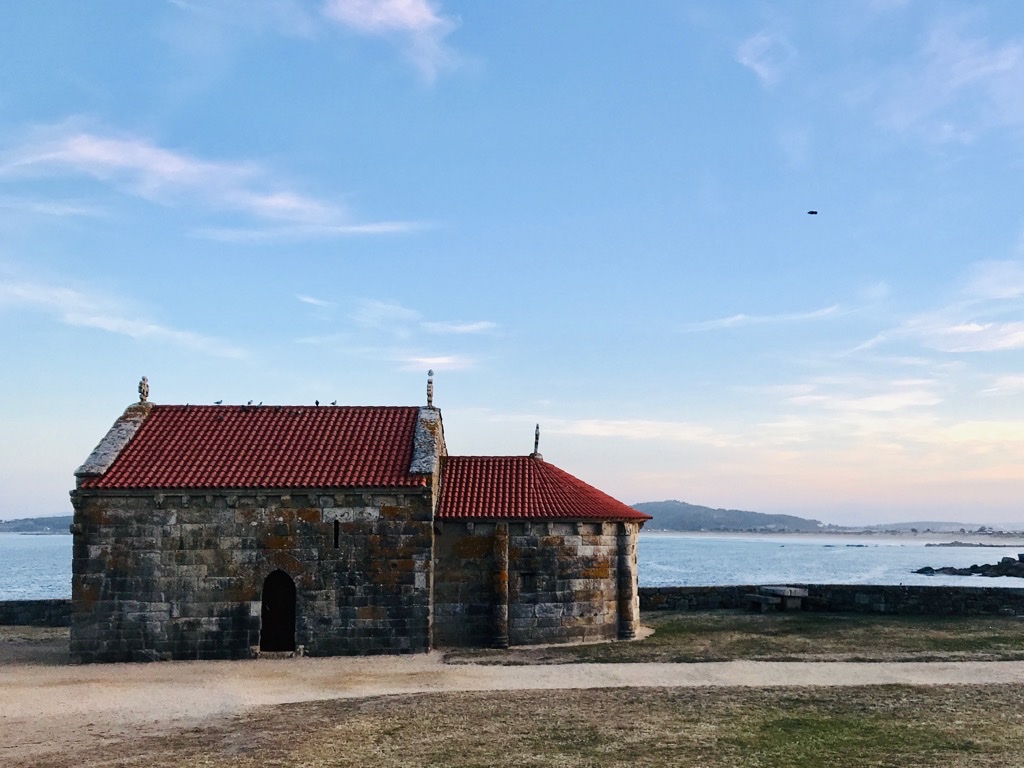
Ermida da Nosa Señora da Lanzada

Most mornings I take Alqo out for a walk before breakfast. In the last week, our walk has become significantly more beautiful, swapping a brisk walk in urban Südstadt to the meadows of Villanueva and now the sea and its jagged, irregular rocky coastline. A few hundred meters away from our place is a small isthmus. The wind has been strong since we arrived to Sanxenxo, so we’d only make it halfway out, to an small meadow where RVs and campers park at night to enjoy the sunsets. But this morning the wind was calm. On this tiny isthmus sits a chapel, the ruins of an old tower, and a pre-Roman settlement.

The Romanesque chapel of Our Lady of Lanzada is a simple affair in juxtaposition with its surroundings. It was built in the 12-century from the ruins of another older chapel, possibly from the time of the tower. Like many older Christian sites, the chapel sits next to something very un-Christian, as if to ward away the pagan gods and worshippers with the Cross.

A castro, a Bronze Age pre-Roman fortified settlement with some remainder of the state walls still visible and preserved, was here long before. And like so many others places, the old rituals mixed with the new and at least tolerable to the Church.

There is a fertility ritual in August on A Lanzada beach called the Bath of the Nine Waves, where women come to the beach to bathe, then sweep the chapel as an offering to the Virgin of Lanzada to cure their infertility.

History is everywhere, if we only find the time to look. Sometimes, the past doesn’t leave artifacts or sites to be toured and admired, only remaining in the legends or historical writings of strangers who came before, closer to the source of time and the people who gave them meaning. But Spain has it all. I think that is why the country is so striking for guiris, there are so many layers of history that fold over each other and onto the present.

A Granxa Galega of Our Own

Three months in California, three in Spain, four in Germany, and back to Spain again. It’s not so much the physical packing and moving that is a grind but the lack of mental finality when we reach a destination. The time when we seem sure that this is for the long haul.

But it’s coming to an end now. Since meeting Patricia in Mauritania and visiting her family in Galicia one summer, I’ve harbored a total fascination with the region. It’s part of Spain. But not the one most Americans think of; siestas, Don Quixote, the fabled historical cities of Andalusia, or the odious bullfighting corridas.

Galicia is something else. Full of chestnut, oak, eucalyptus, and pine trees while fjord-like rías break up the coastline in such a way legend says they are the imprints of God’s fingers after having created the world and rested his hand on Galicia. An old kingdom of Celtic people eventually gave way to Roman retired generals and their progeny and produced the mother language of Galician-Portuguese.

Both of us desire a low-carbon lifestyle in a rural area. Cheap property prices, hundreds of depopulated and abandoned villages, and decent climate in this unpredictable time make Galicia a fertile zone for our generation heading back to the villages. Traditional employment opportunities have been in decline since the financial crisis all over Spain.

But we can combine working remotely, planting and growing our own food, raising animals, harvesting rainwater, renting out an extra room on Airbnb, and having space for family and friends to visit to build the life and community we want to be a part of. It aligns with own politics and thoughts on how to raise a family on a warming planet. Galicia is that place.

Yesterday, we arrived in O Grove, our temporary home base to start our search for a terreno of our own. It might take a while. Since we have our van, we can take short weekend trips to the interior and see what’s available. Finally, we’re thinking long-term.

Doubt and Belonging in Search of Truth

I could quote every paragraph of folio’s post on searching for truth in a time of modern secularity but I’ll leave this gem that resonated with me.

The desire to be a part of a movement or a community of the likeminded is a deceptive diversion from reality: it obscures what we are really called to, replacing personal ethical responsibility with group-think. In contrast to what is commonly taught amongst Muslims, the Qur’an cautions against following herd instinct: “If you obey most people on earth, they will take you away from the easy path of God.” [6:116] Belonging, really, is not what it is all about.

Sometimes I am surprised how little these friends of mine know me, as they bombard me with the ramblings of men linked to me only by a very generic profession of faith. We are not called upon to embrace what others say out of a sense of pious solidarity. The truth is just truth; it is founded on the argument, not on belonging to a particular group or ethnicity. None of this is new.

I’ve tried writing my own thoughts, but it all comes out as gibberish. Soon, God willing.

Rethinking How to Think and Act

“I want to do whatever it takes to make it possible for everyone, around the world, to enjoy a life worth living.” — Who Owns Tomorrow? by Chloe Watlington in Commune

It is May of 2010 and I’m back in California going through a range of emotions; leaving my university life in Oregon, understanding that a short, failed relationship I spent two years desiring was not reciprocated, and the uncertainty of committing to 27 months abroad before I return.

In a Borders Books next to my parents’ house, I play a game; only perusing the Penguin Classics, the spines uniformly with white text on a matte black. Hundreds of them scattered alphabetically over the store. One sticks out with the the title A Little Larger than the Entire Universe. Already deep into vague misreadings of quantum physics and squaring it with Islam, it sounded like something in my wheelhouse. Fernando Pessoa, an unfamiliar name of a famous 20th-century Portuguese poet. The translator and editor of the poetry anthropology in my hands wrote:

Instead of getting down to the practical business of living, he continued to wrestle with theoretical problems and the big questions: the existence of God, the meaning of life and the meaning of death, good vs. evil, reality vs. appearance, the idea (is it just an idea?) of love, the limits of consciousness, and so on. All of which was rich fodder for his poetry, thriving as it did on ideas more than on actual experience.

The intervening years since stumbling on his work have been full of migration, learning, love, faith, and adventure but also of ambiguity, uncertainty and difficulty. But editorial impression, of a life not fully lived but wholly examined and possibly being paralyzed by it, has served as a bizarre measuring stick to my own. I’m infatuated by the written word, of outside perspectives to better understand the world and my place in it. But how far does one accept outside stimuli to live a life?

My active, outside, rural years in Sierra Leone stand in sharp relief to the introspective and inside ones in Mauritania. I’m an extreme person.

I don’t envy Pessoa. He died an alcoholic having rarely left Lisbon after returning from Durban in his teenager years. I left Mauritania to win back my personal relationship with the Divine, away from the legalism and minutiae of a nominally Muslim society. Distance made the heart grow fonder, it seemed. In the wintry Andes and with a few entheogenic plant experiences, I felt reawakened and clear-eyed.

Now it is 2019. Now surrounded by the modern city life, I feel too tuned in to what is happening in the world. And it looks grim.

There are some who say we are doing much better than we ever have in human history. Then why does it feel so shitty?

Climate change, the normalization of racism and xenophobia, rising inequality and our potential responses are our generation’s World Wars or Paris Commune. Just as Rumi’s family anguished and migrated to escape the world-ending devastation of the Mongol invasion, we have our world-ending scenarios that we must face.

We must educate ourselves and others. We must reject false choices and centrism. And then we must organize ourselves accordingly in a way that respects and protects all life from the fevered egos that see the world as a zero-sum game.

I become more class conscious and eco-conscious by the day. I’m an extreme person. No longer does it seem right for me to travel around on planes as often as I did. Or buy everything wrapped in plastic, the micro-remnants of which are now in almost every living being, when a bit of planning and with the abundance of alternatives.

With time comes more understanding and responsibility.

“I take my desires for reality because I believe in the reality of my desires.” — Paris, May 1968

I add the words hope in the late anthropocene to the existing tagline at the top to reflect my desires in this reality. I commit myself to working on solutions and not adding to the despair.

Thanks for reading, seriously.
Six Seventy Four

It has been almost two years since leaving my life in Mauritania. Since then, my wife and I attended my brother’s wedding in California, backpacked for a year from Mexico to Peru, spent the summer visiting family and friends in the United States, took a road trip with a Prius and a tent from California to Oklahoma and back, wintered outside Madrid, bought and converted a campervan, and took two three-week trips before finally reaching in Cologne yesterday. We had been planning this move for months but we wanted to wait for the winter. And the extra months in Spain gave me the opportunity to really improve my Spanish comprehension.

And now, a new chapter emerges; living in a city, navigating life in a new language, project-based work with friends, and another region to explore.